





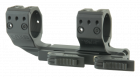
Spuhr ISMS QDP-6016 Ø36mm Tube 0 MIL (34 mm High) Cantilever Quick Detach Picatinny Scope Mount
"The Spuhr ISMS QDP 36mm mount combines durability with effortless quick-detach functionality. Its zero-MOA design keeps your optic aligned perfectly after removal and remounting, while the robust construction handles recoil with ease. Perfect for high-end rifles and precision optics, the QDP-6016 is a dependable choice for shooters who demand reliability and convenience." - Thomas.

Finance Calculator
Representative Calculation
Powered by Autify Digital Ltd


#1451

#1450

#1444

#1447

#1445
The Spuhr ISMS (Ideal Scope Mount System) is a high-performance mounting solution engineered for shooters who demand unmatched stability, precision, and modular versatility. Its single-piece, billet-machined aluminium construction provides exceptional rigidity, virtually eliminating flex under recoil and ensuring repeatable zero for long-range, tactical, and competition applications.
The system’s diagonally split rings give unobstructed access to elevation and windage turrets, allowing fast and precise adjustments without interference. An integrated levelling system and alignment wedge ensure the optic is perfectly level during setup, critical for extreme-range accuracy and consistent shot placement.
Multiple interface points along the mount allow secure attachment of a wide range of accessories, from lasers and rangefinders to backup optics and night-vision devices, without affecting rifle balance or ergonomics. Machined from aerospace-grade aluminium and finished with hard-anodised coating, the ISMS offers exceptional durability, corrosion resistance, and mechanical integrity under heavy recoil and field conditions.
With its combination of precision machining, modular functionality, and rock-solid strength, the Spuhr ISMS is designed to elevate any rifle platform, providing a foundation for accurate, repeatable, and adaptable long-range performance.
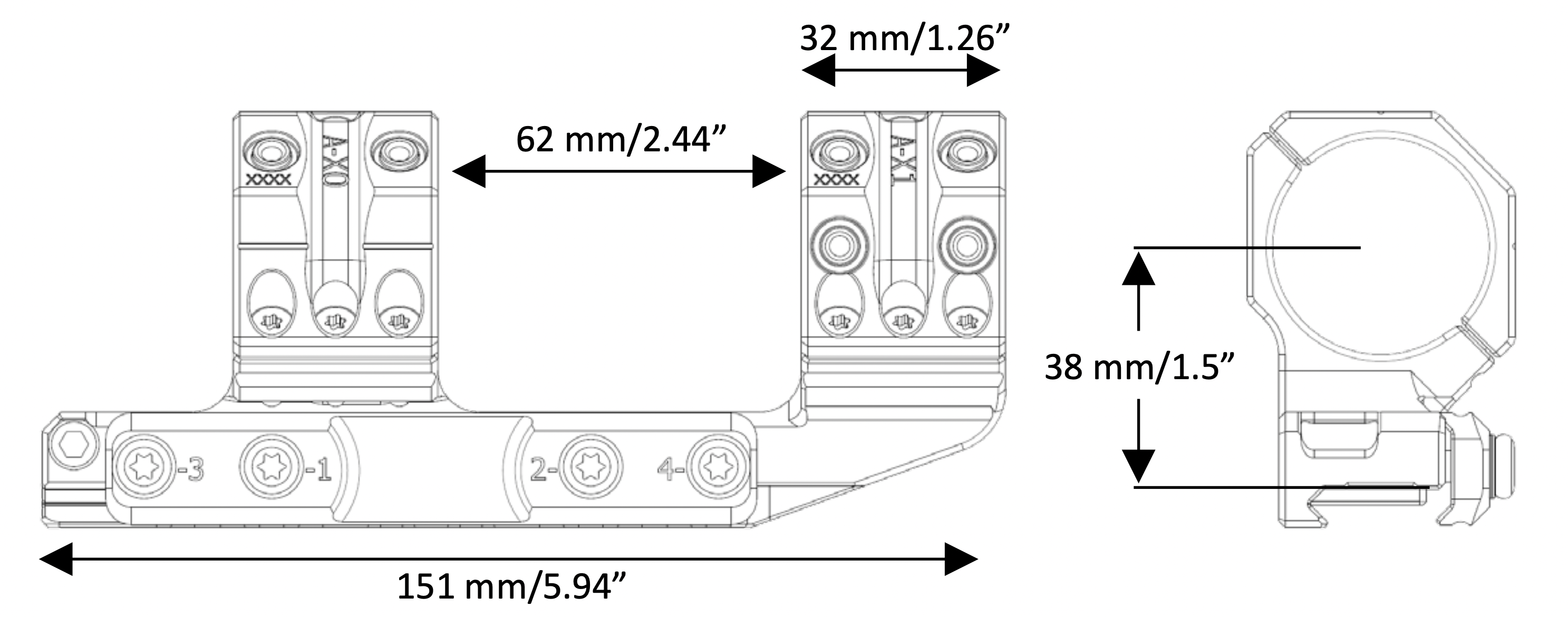
Ring Height - 38mm

Spuhr ISMS QDP-6016 36mm High (38mm) Quick Detach 0 MOA Cantilever Mount
Picatinny mount for use on AR10 rifles
Rings: 36 mm
Tilt: 0 MIL/MOA
Height: 38 mm/1.5”
Length: 151 mm/5.94” (mount body only)
Weight: 289 g/10.2 oz
Interfaces: 8 sets
EAN: 7340150705275
10-degree wedge included
-
Monolithic one‑piece construction - CNC‑machined from a single billet of aerospace‑grade aluminium to eliminate tolerance stacking, flex, and ring misalignment common in multi‑piece mounts.
-
High‑rigidity structural geometry - Optimised cross‑section and material distribution provide exceptional torsional and vertical stiffness, maintaining optic alignment under heavy recoil and dynamic loading.
-
Hard‑anodised surface treatment - Type III hard anodising delivers excellent abrasion resistance, corrosion protection, and a non‑reflective tactical finish.
-
Diagonal ring split design - Improves load distribution around the scope tube while keeping elevation and windage turrets fully accessible, preventing obstruction during adjustment.
-
Integrated scope levelling system - Built‑in bubble level allows the shooter to reference rifle cant and optic alignment directly on the mount for precise long‑range shooting.
-
Multi‑axis accessory interface - Machined mounting points on multiple faces of the mount support direct attachment of optical and electronic accessories without adding separate rails.
-
Low‑profile accessory mounting - Keeps mounted devices close to the bore axis and centre of mass, preserving rifle balance and minimising parallax and offset errors.
-
Precision‑cut recoil lugs and rail interface - Provides repeatable, slip‑free engagement with Picatinny rails for consistent return‑to‑zero performance.
-
High‑strength fastener system - Torque‑optimised fasteners maintain clamping force under vibration and recoil, preventing optic movement or zero shift.
- Designed for extreme‑range precision - Engineered to support the mechanical and optical demands of ELR, PRS, and professional long‑range shooting platforms.
How does the mount handle the additional mass of large 36mm tube scopes?
Large 36mm scopes place greater inertial loads on the mount during recoil and transport. The rigid one-piece structure distributes these loads evenly across the rail interface, preventing localized stress that could lead to movement or alignment changes.
Does a larger scope tube diameter require different torque practices?
Maintaining consistent torque becomes more important with larger diameter tubes because uneven compression can create subtle distortions. Using a calibrated torque wrench ensures even clamping pressure and helps preserve smooth turret tracking.
How does optic weight affect return-to-zero consistency with this mount?
Heavier optics increase the load on the cam-lock interface, making consistent lever tension especially important. When properly adjusted, the mount maintains reliable return-to-zero even with large tactical optics.
Does the mount reduce the risk of tube deformation in large precision scopes?
The coaxial ring alignment provided by the monolithic construction minimizes bending forces on the scope tube. This is particularly beneficial for large 36mm optics where tube stiffness varies between manufacturers.
How sensitive is the QD interface to rail dimensional variation?
Small differences in Picatinny rail geometry can influence how the mount seats against the recoil surfaces. Consistently using the same rail slots helps maintain predictable positioning and repeatable zero.
Can the mount maintain alignment with heavy accessory loads attached?
The integrated structure distributes accessory loads across the mount body rather than concentrating stress at individual rings. Moderate accessory weight generally has no measurable effect on optical alignment.
Does repeated removal accelerate wear on the cam-lock system?
The cam surfaces are designed to withstand many installation cycles without significant wear. Regular cleaning of contact surfaces helps maintain smooth operation and consistent clamping force.
How does rail interface engagement resist recoil-induced movement?
The mount engages the forward faces of the Picatinny slots to resist recoil forces. This mechanical engagement works together with clamping friction to prevent forward creep during repeated firing.
Can improper lever tension affect precision at long range?
Inconsistent lever preload can allow small variations in mount seating position. These small changes can become noticeable at extended distances where minor alignment differences translate into measurable point-of-impact shifts.
How does mount rigidity affect optical tracking consistency?
A rigid mount maintains a stable optical axis relative to the bore during recoil and vibration. This stability helps ensure that turret adjustments correspond accurately to point-of-impact changes.
Does mounting position influence system stability with large optics?
Placing the mount fully on a rigid receiver rail reduces the potential for flex-induced shifts. Mounting across separate rail sections may introduce small alignment changes under recoil.
How does the mount behave under repeated recoil cycles?
The structure distributes recoil loads across multiple contact surfaces, preventing progressive movement. Properly installed mounts typically maintain zero through extensive firing cycles.
Can ring torque influence parallax adjustment behavior?
Uneven ring pressure can slightly distort the scope tube and affect the smoothness of internal adjustments. Consistent torque helps ensure predictable parallax and magnification operation.
Does the mount help prevent reticle cant caused by movement?
The rigid ring alignment helps maintain the rotational orientation of the scope tube. Once properly leveled and torqued, the mount resists rotation even under heavy recoil.
How does the mount respond to environmental temperature changes?
Uniform thermal expansion maintains the relative alignment between rings and base. Environmental temperature shifts generally produce negligible influence on zero stability.
Can debris between the mount and rail affect repeatability?
Foreign material between the mount and rail can prevent full seating against the recoil surfaces. Even small particles can introduce slight alignment differences that affect return-to-zero performance.
How resistant is the mount to impact during transport or field use?
The monolithic structure spreads impact forces throughout the mount body. This reduces the likelihood of ring misalignment or permanent deformation following moderate impacts.
Does the mount require periodic maintenance?
Routine inspection of lever tension and ring screw torque is recommended for long-term reliability. Keeping the rail interface clean also helps preserve consistent mounting behavior.
Can rail wear influence long-term consistency?
Wear on softer aluminum rails can gradually change the way the mount seats under clamping pressure. Monitoring rail condition helps maintain repeatable installation.
Does the mount prevent scope movement under heavy recoil?
Properly torqued rings generate sufficient friction to prevent axial scope movement. Clean contact surfaces are important to maintain this retention over time.
How does the mount resist torsional forces from large optics?
Wide ring spacing and a rigid base help resist twisting forces created during recoil. This keeps the reticle aligned with the bore axis and preserves zero stability.
Can lever adjustment change point of impact?
Changing lever tension alters clamping preload and can slightly change the mount’s seating position. Any adjustment should be followed by zero verification.
Does repeated installation affect ring alignment?
Ring alignment is maintained because the rings are machined into a single structure. Removal and reinstallation do not alter the internal ring geometry.
How does mount stiffness influence shot-to-shot consistency?
A stiff mounting interface minimizes micro-movement between the optic and rifle during recoil. This contributes to consistent point-of-impact behavior across firing strings.
What installation factors most influence long-term reliability?
Consistent torque values and proper lever adjustment are the most important factors in maintaining stability. Clean rail contact surfaces and consistent slot placement also play a major role.
Our aim is to ensure that your order arrives with you as soon as possible and in the safest, most cost-effective means.
Please Note: Shipping charges may be subject to additional surcharges if out of area or over weight restrictions.
Please Note: DPD SHIPMENTS REQUIRE THE CUSTOMER TO SHOW A PIN CODE ON DELIVERY - READ MORE: HERE
COURIERS
 |
 |
 |
 |
We use DPD , RoyalMail, TNT and UPS courier services for all our orders whether dispatching to the UK or International. As soon as your order has been dispatched you will receive an email with your unique tracking number. We are unable to add delivery notes to your order regarding safe spaces or neighbour deliveries. If you require this service it can be arranged directly with the courier once the parcel is in their network.
IN-STORE ITEMS
These are items that we have in-stock and will be sent out for delivery as soon as possible. We aim to dispatch all orders within 1-2 working days, but during busy periods dispatch may be delayed by a day or so. If you would like to purchase the item in person then please call ahead to arrange an appointment: 01803 611 895.
PRE-ORDER ITEMS
These are usually items that are going to be out-of-stock for a number of weeks or are in short supply. By purchasing a Pre-Order Item you are in effect paying a deposit for your goods. As soon as the item is back in stock yours will be dispatched within 24 hours where possible. Please see individual product pages for current back-in-stock dates. In rare occasions, these dates can be changed by the manufacturers so we recommend staying in contact with Optics Warehouse depending on the product lead time.
INTERNATIONAL DELIVERY & TAXES
In addition to the above information If your delivery address is outside of the UK you may be subject to import duties and taxes, which are levied once a shipment reaches your country. Any such additional charges for customs clearance must be borne by you. You should note that customs policies vary widely from country to country. Optics Warehouse advises each customer to contact their local customs office for further information if they are in any way unsure of local duties or liabilities. Cross border shipments are subject to opening and inspection by customs authorities which means some packages may be opened and re-sealed.
NEED HELP?
If you require any further assistance, please call us on 01803 611 895 or email sales@opticswarehouse.co.uk
-
A NOTE ABOUT DPD SHIPMENTS:
- Please be advised that we have now introduced DPD Pins to all DPD orders from Optics Warehouse.
- If your shipment is being sent from Optics Warehouse via DPD you will be sent a Pin Code that must be shown to the courier upon delivery.
- The pincode is sent VIA email & TEXT message. A valid email address and mobile number must be provided at checkout. Emails will be sent from "Riviera House 3PL" - if you do not receive this email please check your junk or spam folders.
- Please note that if you do not display your pin code to the courier driver upon delivery, you will not be able to have your item and you may need to schedule another delivery date to show a valid pin.
- Please view the attached slides HERE for further information!
Please note: All clearance calculations are based on mounts with 0 MOA. While MOA can be factored in, actual clearance may vary due to variables that can't always be accurately calculated. If you're considering an MOA mount and are unsure about the required height, we recommend contacting our sales team directly.

Measure the outermost diameter of your scope’s objective bell (including any flare).

Measure the thickness of any scope cover if used. If none, leave as 0.

Measure from the top of the rail to the highest point of the barrel.
We add a little extra clearance to account for real-world variation. Default is +1 mm.
Enter your measurements above to calculate the lowest ring height (base-to-centre) you can realistically use.

(A + 2×B) / 2 − C + TWhere A = objective outer diameter, B = cover thickness, C = rail-to-barrel clearance, T = tolerance.