










HIKMICRO Thunder 4.0 Thermal Clip-Ons: Features, Performance & Key Differences
You have spent time getting a day scope zeroed and set up on your rifle, and you may not want to give it up to go thermal. A thermal front clip-on lets you keep it, adding a thermal image in front of the day scope instead of replacing it. The HIKMICRO Thunder 4.0 comes in three sizes: the 35mm and 50mm lens models with a 640 × 512 sensor, and the 70mm lens TX70CL with a 1280 × 1024 sensor. All three have a laser rangefinder built in, and the right one depends on how far you shoot and how often you zoom in.
Quick Answer: Which Thunder 4.0 Should You Buy?
Choose the TQ50CL (640 × 512, 50mm F1.0, RRP £2,599.99) if you want one clip-on for foxing and pest control across farmland and open ground. It is the all-round pick: a proven lens length for open-field shooting, a 15.4m-wide view at 100m, and the same sensitivity and rangefinder as the dearer model.
Choose the TQ35CL (640 × 512, 35mm F1.0, RRP £2,199.99) if you shoot mostly woodland edges and mixed ground at shorter range. It has a wider view, is the lightest of the three at 542g and is the cheapest way in.
Choose the TX70CL (1280 × 1024, 70mm F1.3, RRP £3,899.99) if you need to judge animals at distance, for long-range pest control or professional deer work. It holds four times the pixels of the 640 models and gives a view as wide as the 35mm model's, with twice the detail across it.
All three share the same sub-12mK sensitivity, a built-in 1,200m laser rangefinder, the same 6,000J recoil rating and a recommended day scope range of 1× to 15×.
The Use Case: Why Choose a Clip-On
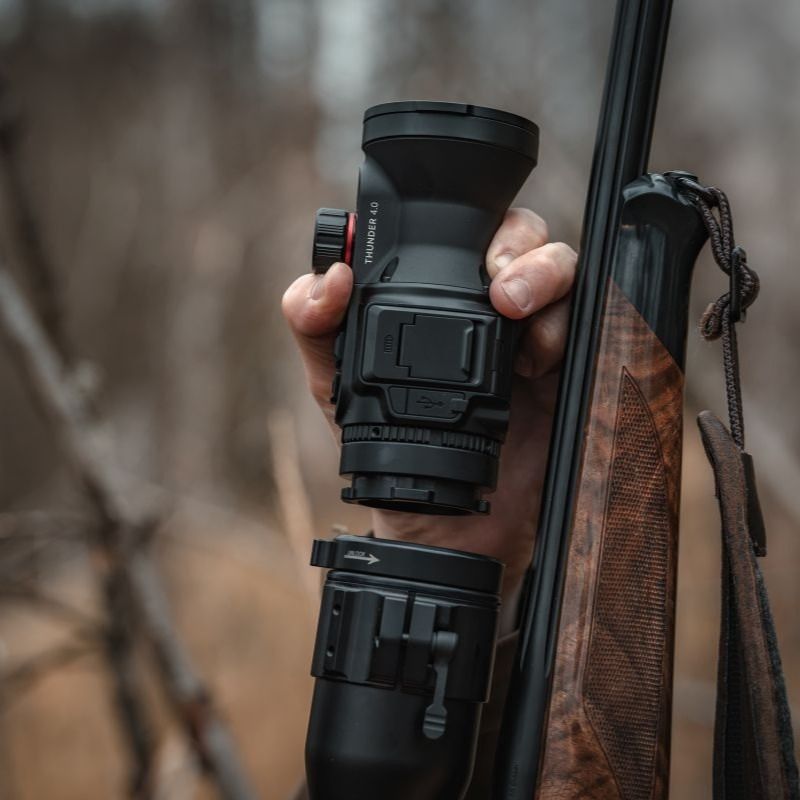
A front clip-on fits to the front of your existing day scope, so you keep your scope, your rings and your zero. The thermal image is displayed in front of the day scope's objective, and you magnify it using the day scope's own zoom. You can also use the unit by hand as a thermal monocular, then fit it to the rifle when it is time to shoot. HIKMICRO lists a handheld zoom range of 2.3× to 18.4× on the TQ35CL, 3.4× to 27.2× on the TQ50CL and 2.4× to 19.2× on the TX70CL.
The trade-offs are real. A clip-on adds weight at the front of the rifle, and it has to be fitted in the dark before the shot. If you would rather have one integrated unit, a dedicated thermal rifle scope may suit you better. Our guide to thermal monocular vs thermal rifle scope helps you decide which to buy first.
For foxing, pest control and deer work, we weigh a clip-on on these points, in this order:
Identification detail at distance. Seeing that something is warm is easy. Being sure what it is, and what is behind it, takes image detail.
Thermal sensitivity (NETD). On damp, mild nights an animal has less temperature contrast against its background, so a lower figure helps.
Usable zoom. You magnify the thermal image through your day scope, so how much native detail the sensor holds decides how far you can go before it breaks down. HIKMICRO recommends a day scope magnification of 1× to 15×.
Zero. Your zero should stay put when the clip-on is fitted, and the unit must withstand recoil.
Ranging. A measured distance removes guesswork at foxing ranges and beyond.
Field of view. This decides how quickly you can scan before committing to a shot.
Weight, balance and battery. These matter on long sessions, especially off a bipod or from a high seat.
|
Specification |
TQ35CL |
TQ50CL |
TX70CL |
|---|---|---|---|
|
Thermal sensor (12µm) |
640 × 512 |
640 × 512 |
1280 × 1024 |
|
NETD (at 25°C, F#=1.0) |
Below 12mK |
Below 12mK |
Below 12mK |
|
Lens |
35mm, F1.0 |
50mm, F1.0 |
70mm, F1.3 |
|
Field of view (degrees; metres at 100m) |
12.5° × 8.0°; 21.9 × 14.0m |
8.8° × 7.0°; 15.4 × 12.2m |
12.8° × 10.3°; 22.4 × 18m |
|
HIKMICRO detection range |
1,800m |
2,600m |
3,500m |
|
Handheld zoom range |
2.3× to 18.4× |
3.4× to 27.2× |
2.4× to 19.2× |
|
Dimensions (mm) |
125 × 64 × 64 |
119.5 × 64 × 64 |
135 × 64 × 64 |
|
Weight with battery (g) |
542 |
560.3 |
575 |
|
Battery life (25°C, LRF on, hotspot off) |
6 hours or more |
6 hours or more |
5 hours or more |
|
Working temperature |
-30°C to +55°C |
-30°C to +50°C |
-30°C to +50°C |
|
RRP |
£2,199.99 |
£2,599.99 |
£3,899.99 |
|
SKU |
HM-TQ35CL4.0 |
HM-TQ50CL4.0 |
HM-TX70CL4.0 |
Shared across all three: 1× magnification at the unit, a 50Hz frame rate, a 1920 × 1080, 0.49-inch AMOLED display, a focus knob and a 10m minimum focus distance. Image processing includes HIKMICRO's Image Pro 4.0, Sync Pro and the shutterless HSIS system. There are five zeroing profiles, image calibration, a virtual reticle, recoil-activated recording with audio, 64GB of onboard storage and six colour palettes. The body and lens cover are magnesium alloy, the centre height is 31mm and the rating is IP67. The built-in laser rangefinder is 905nm Class 1.
What the Lens and Sensor Choice Actually Change
The TX70CL's 1280 × 1024 detector holds 1,310,720 pixels against 327,680 on the TQ35CL and TQ50CL, exactly four times as many. That is a fact. What it means in the field is interpretation:
1280 × 1024 sensor → more native thermal information → more detail still available as you zoom the day scope → easier assessment of animals at distance → most useful to shooters who need to judge what they are looking at, not just that something is there.
The published fields of view let us put rough numbers on the detail. At 100m, the TQ35CL spreads a 21.9m-wide view over 640 pixels, about 3.4cm per pixel. The TQ50CL spreads 15.4m over 640 pixels, about 2.4cm. The TX70CL spreads 22.4m over 1280 pixels, about 1.75cm. This is our own calculation from HIKMICRO's specifications, horizontal only and approximate.
That gives three useful comparisons:
TX70CL against TQ35CL: a view of almost the same width (22.4m against 21.9m), with roughly twice the detail across it.
TX70CL against TQ50CL: a view about 45% wider, with roughly 1.4 times the detail.
TQ50CL against TQ35CL: the longer lens narrows the view by about 30% in return for finer detail and more reach.
This is why the lens decision is really a choice about ground. The 35mm gives you the widest 640 view, the 50mm gives you reach for open fields, and the 70mm with the larger sensor gives you reach without the narrow view.
Sensitivity is the same. All three list NETD below 12mK, measured at 25°C and F#=1.0, which is better than the 15mK point where our thermal scoring framework's top band begins. Note that the TX70CL's lens is F1.3, so we would compare the three side by side in the field before assuming identical performance on a marginal night.
Detection range is not identification range. HIKMICRO quotes 1,800m, 2,600m and 3,500m for the three. Those describe detection under defined test conditions. They are not distances at which you can identify an animal or safely take a shot.
A 640 × 512 clip-on remains an excellent tool at the distances where most foxing and pest control happens. The TX70CL earns its extra cost when ranges are longer, when you zoom in as a matter of routine, or when misidentifying an animal matters.
Built-in LRF, Zeroing, Recoil Rating and Fitting
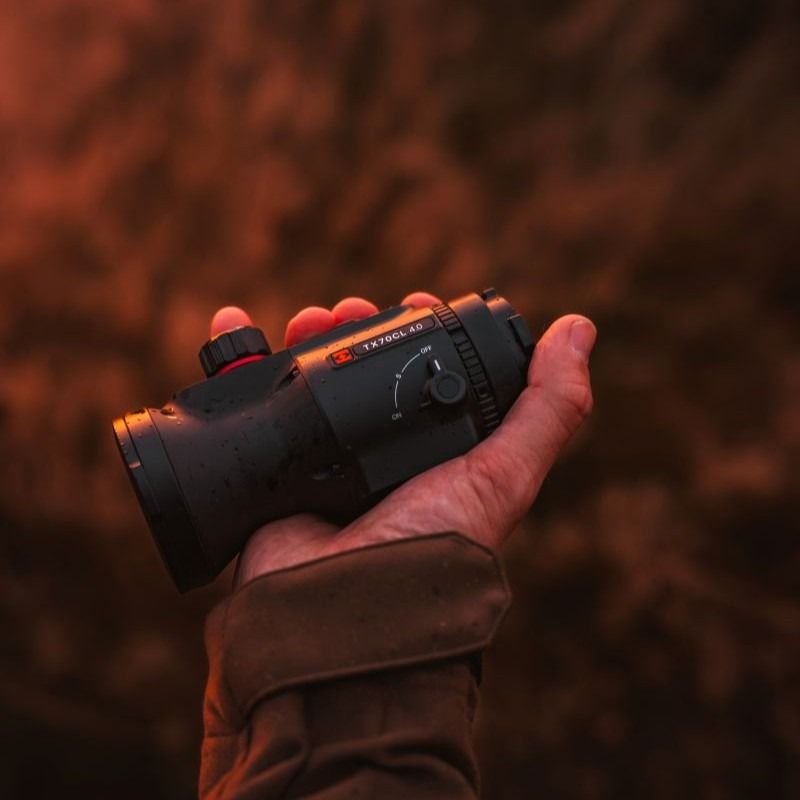
Laser rangefinder. All three models have a 905nm Class 1 laser rangefinder built in. It measures from 10m to 1,200m, with ±1m accuracy under 400m and ±0.3m beyond 400m. The practical chain is: integrated LRF → a measured distance without a separate device → a holdover you can work out for that distance → fewer misjudged shots at the longer ranges where drop and wind start to matter.
Aiming and ballistics. You aim through your day scope, so its reticle does the work. The clip-on has no reticle of its own, although HIKMICRO also lists a virtual reticle. The datasheets list no ballistic calculator on these units, so use the measured range with your day scope's reticle, turrets or your own ballistic app.
Zero and recoil. HIKMICRO rates all three to 6,000J of recoil, lists five zeroing profiles and image calibration, and quotes "1MOA guaranteed precision" among the key features. For reference, 1 MOA is about 29mm at 100m. Treat these as the manufacturer's figures and check your zero with the clip-on fitted, as you would with any add-on. Recoil-activated recording, with audio, saves footage automatically around each shot.
Fitting to your day scope. HIKMICRO recommends a day scope magnification of 1× to 15×. The datasheets do not say which adapters fit which scopes, so measure the outside diameter of your day scope's objective bell. A snug fit is what keeps the clip-on and your zero steady.
Power. All three use an HM-3840DC battery, which the TX70CL datasheet describes as rechargeable and replaceable, and charge over USB-C (5V, 2A). It also supports external power and direct charging. Quoted runtime is 6 hours or more for the TQ35CL and TQ50CL and 5 hours or more for the TX70CL, with the LRF on and hotspot off at 25°C.
Compromises to Weigh Up
Weight at the front. The units weigh 542g to 575g with the battery, all added ahead of your day scope. That will shift the balance, especially on a lighter rifle or when shooting freehand. A bipod, sticks or a high seat suit them best.
Fitting in the dark. If you scan by hand and then mount the unit, you need practice to do it quickly and quietly before the animal moves on.
Day scope zoom. HIKMICRO recommends 1× to 15× on the day scope. If you usually shoot at higher magnification, check that this suits you.
Fitment. Clip-ons depend on a good fit to your scope's objective. The datasheets do not list compatible scopes or adapters.
Battery life. The TX70CL runs for 5 hours or more against 6 hours or more for the others, all with the LRF on at 25°C. Cold weather will reduce this, as it does for any battery.
Minimum focus. 10m on all three, so they are not close-range ratting tools.
Price. The TX70CL costs £1,300 more than the TQ50CL, about 50% above it, and £1,700 more than the TQ35CL. The TQ50CL costs £400 more than the TQ35CL, about 18%. For occasional use at shorter distances, the extra money may be better spent elsewhere.
Operating temperature. The TQ35CL works from -30°C to +55°C. The TQ50CL and TX70CL are rated -30°C to +50°C.
Who Should Buy Which?
The TQ35CL suits shooters working woodland edges, rides and mixed ground at shorter range, who want the widest 640 view, the lowest weight and the lowest price. It is also a sensible first step into thermal for someone who wants to keep their day scope.
The TQ50CL suits most fox and pest shooters on farmland and open ground. It is the all-round choice, with reach for field distances and the same sensitivity, rangefinder and recoil rating as the others.
The TX70CL suits professional deer managers, stalkers and contractors who need to judge animals at distance, and long-range pest-control shooters who zoom in routinely. It is for people whose ground or work uses the extra detail often enough to justify the cost.
Who may prefer something else?
If you want one integrated unit rather than fitting a clip-on before each shot, a dedicated thermal rifle scope may suit you better. Our thermal monocular vs thermal rifle scope guide covers the choice.
If you want to see our other options for fitting thermal to a day scope, browse our thermal clip-on range, which includes the HIKMICRO Thunder 3.0 series.
For close-range pest control with an air rifle, a lighter scope with closer focus will handle better than any of the three.
OPW View
The Thunder 4.0 gives you a way to add thermal to a rifle you already shoot well, with a built-in 1,200m rangefinder, the same sub-12mK sensitivity across the range and a rating of 6,000J of recoil. What separates the three models is how much of the scene you see and how much detail you keep.
For most fox and pest shooters, the TQ50CL is the sensible choice. For woodland and mixed ground at shorter range, the TQ35CL is lighter, wider and £400 cheaper.
The TX70CL is for those who will use what it adds. A 1280 sensor behind a 70mm lens gives a view as wide as the 35mm model's with roughly twice the detail across it, and for deer management and long-range work that is worth paying for.
Our advice is to decide on your ground, your distances and your day scope first, then pick the clip-on.
FAQ
What is the difference between the TQ35CL, TQ50CL and TX70CL?
The TQ35CL has a 640 × 512 sensor and 35mm F1.0 lens. The TQ50CL has the same sensor with a 50mm F1.0 lens. The TX70CL has a 1280 × 1024 sensor and 70mm F1.3 lens. All three share NETD below 12mK, a 1,200m laser rangefinder and a 6,000J recoil rating.
What is a thermal front clip-on?
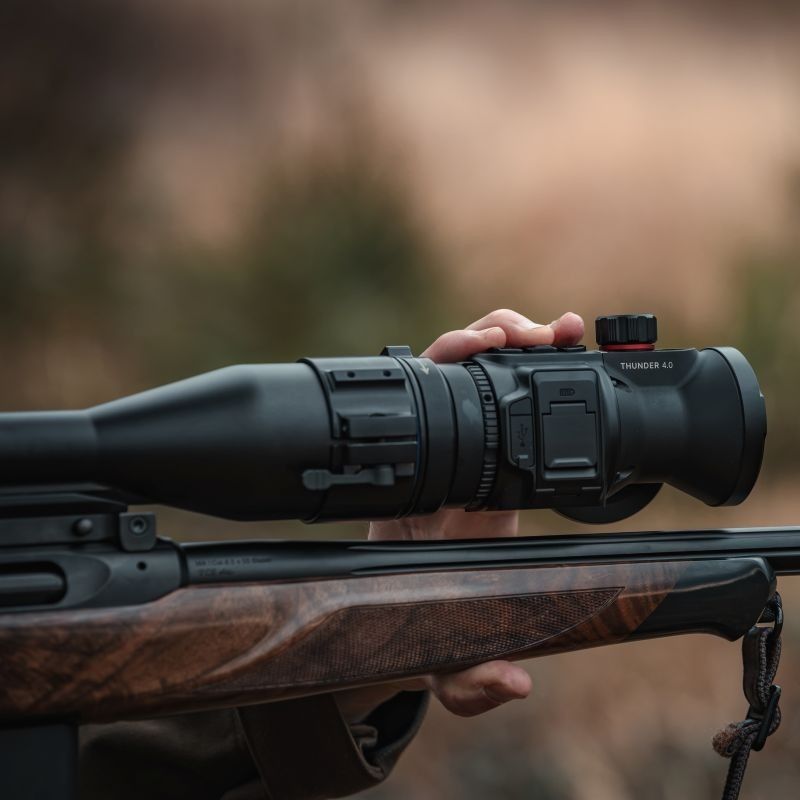
It fits to the front of your day scope and displays a thermal image that you view and magnify through that scope. You keep your own scope, rings and zero.
Does the Thunder 4.0 have a laser rangefinder?
Yes. All three have a 905nm Class 1 laser rangefinder built in, measuring from 10m to 1,200m. Accuracy is ±1m under 400m and ±0.3m beyond.
What day scope magnification should I use?
HIKMICRO recommends 1× to 15×.
Can I use it without a rifle?
Yes. HIKMICRO lists a handheld zoom range of 2.3× to 18.4× for the TQ35CL, 3.4× to 27.2× for the TQ50CL and 2.4× to 19.2× for the TX70CL.
Is 1280 worth the extra money over 640?
It depends on your use. The TX70CL carries four times the native pixels and keeps more detail when you zoom, which matters most for deer management and longer-range work. For foxing at typical ranges, a 640 model is already very capable.
Is the detection range the same as the distance I can identify an animal?
No. HIKMICRO's 1,800m, 2,600m and 3,500m figures are detection ranges under defined conditions. How far you can identify and safely shoot depends on the animal, the conditions and the situation.
Does it have a ballistic calculator?
The datasheets do not list one. Use the measured range with your day scope's reticle, turrets or your own ballistic app.
How long does the battery last?
HIKMICRO quotes 6 hours or more for the TQ35CL and TQ50CL and 5 hours or more for the TX70CL, with the LRF on and hotspot off at 25°C.