










HIKMICRO Stellar 4.0 Thermal Riflescopes: SQ50 vs SX75 – Features, Performance & Key Differences
A thermal rifle scope has to do something a handheld spotter never does: hold zero under recoil while giving you enough image detail to be sure of what you are shooting at. The HIKMICRO Stellar 4.0 is built around that job, with a familiar riflescope shape, side focus, a rear magnification ring and a built-in laser rangefinder. It launches in two sizes, the 640 × 512 SQ50 and the 1280 × 1024 SX75, and the right one depends far more on your ground than on the spec sheet.
Quick Answer: Which Stellar 4.0 Should You Buy?
Choose the SQ50 (640 × 512, 50mm F1.0, RRP £3,249.99) if you shoot foxes and pest from woodland edges to open farmland, want the lighter scope and the longer battery life, and do not need to push the zoom far. It is the more rational buy for most UK night shooters.
Choose the SX75 (1280 × 1024, 75mm F1.2, RRP £4,999.99) if you regularly need to assess animals at distance, whether that is long-range foxing or professional deer management. It carries four times the native pixels and a wider field of view than the SQ50, so you give up less scanning width than you might expect.
Both share the same sub-12mK sensitivity, the same 6000J recoil rating, the same 1200m laser rangefinder and the same five zeroing profiles. The decision comes down to detail at distance against weight and battery life.
Each comes in two versions. The L models take standard 30mm rings and the LR models are rail-mounted.
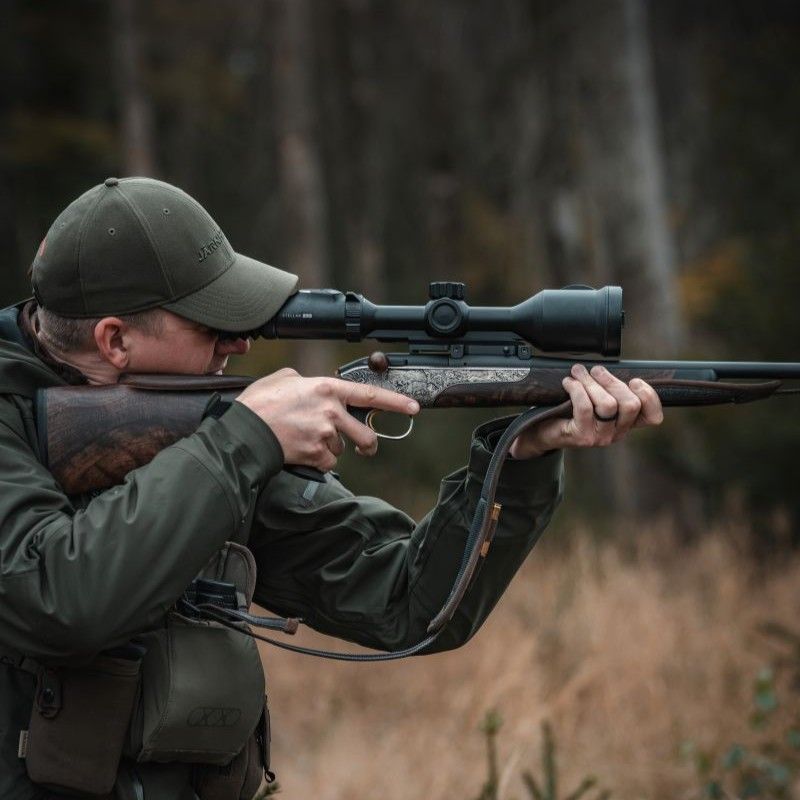
The Use Case: What a Thermal Rifle Scope Has to Get Right
A thermal spotter only has to find the animal. A thermal rifle scope has to find it, tell you what it is, hold your zero through recoil and put a distance and holdover on it, all without you changing devices or taking your eye off the target.
That changes which specifications matter. For foxing, long-range pest control and deer management, we weigh them in roughly this order:
Identification detail at distance. Detecting a heat source is the easy part. Being confident about what it is, and what is behind it, takes image detail.
Thermal sensitivity (NETD). Damp, mild nights reduce the temperature difference between an animal and its background. A lower figure helps in exactly those conditions.
Usable zoom. Digital zoom enlarges the image but cannot add native detail, so the amount of detail the sensor starts with sets how far you can zoom before the picture breaks down.
Zero retention. The scope must stay on target shot after shot on the rifle you actually use.
Ranging and ballistic tools. A measured distance and a holdover remove guesswork at foxing ranges and beyond.
Field of view and base magnification. These decide how quickly you can scan ground before you commit to a shot.
Weight and battery life. These matter on long sessions, especially from a high seat or on a stalk.
The Stellar 4.0 Range at a Glance
The two sizes differ in sensor, lens, size and price. Almost everything else is shared.
|
Specification |
SQ50 |
SX75 |
|---|---|---|
|
Thermal sensor (12µm, VOx) |
640 × 512 |
1280 × 1024 |
|
NETD |
Below 12mK |
Below 12mK |
|
Lens |
50mm, F1.0 |
75mm, F1.2 |
|
Magnification |
3.5× to 28× |
3.0× to 30× |
|
Field of view (degrees; metres at 100m) |
8.8° × 7.0°; 15.2 × 12.2m |
12.1° × 9.7°; 21.2 × 17m |
|
HIKMICRO detection range |
2,600m |
3,600m |
|
Laser rangefinder |
1,200m, ±1m |
1,200m, ±1m |
|
Dimensions (mm) |
439.6 × 82.9 × 74.3 |
445.7 × 93.5 × 78.7 |
|
Centre height (mm) |
36 |
41 |
|
Weight with external battery: L / LR (g) |
1,008 / 1,073 |
1,075 / 1,140 |
|
Battery life (25°C, LRF on) |
9.5 hours |
7 hours |
|
RRP |
£3,249.99 |
£4,999.99 |
The four models are:
|
Model |
Sensor and lens |
Mounting |
RRP |
|---|---|---|---|
|
640 × 512, 50mm |
Standard 30mm |
£3,249.99 |
|
|
640 × 512, 50mm |
Rail |
£3,249.99 |
|
|
1280 × 1024, 75mm |
Standard 30mm |
£4,999.99 |
|
|
1280 × 1024, 75mm |
Rail |
£4,999.99 |
Shared across all four: a 1.03-inch, 2560 × 2560 AMOLED display, a 50Hz frame rate, 8mm exit pupil, 55mm eye relief and ±5 dioptre adjustment. Image processing includes HIKMICRO's Image Pro 4.0, Zoom Pro, Sync Pro and the shutterless HSIS system. For shooting there are five zeroing profiles, freeze zeroing, a ballistic calculator, recoil-activated recording with audio, 64GB of onboard storage and six colour palettes. They are rated IP67 and for use from -30°C to 55°C.
In the box you get a quick start guide, USB-C cable, lint-free cloth, two batteries, a battery charger, a carry bag and a scope guard. HIKMICRO backs the range with a 3-year product warranty, 1 year on the batteries and 10 years on the detector.
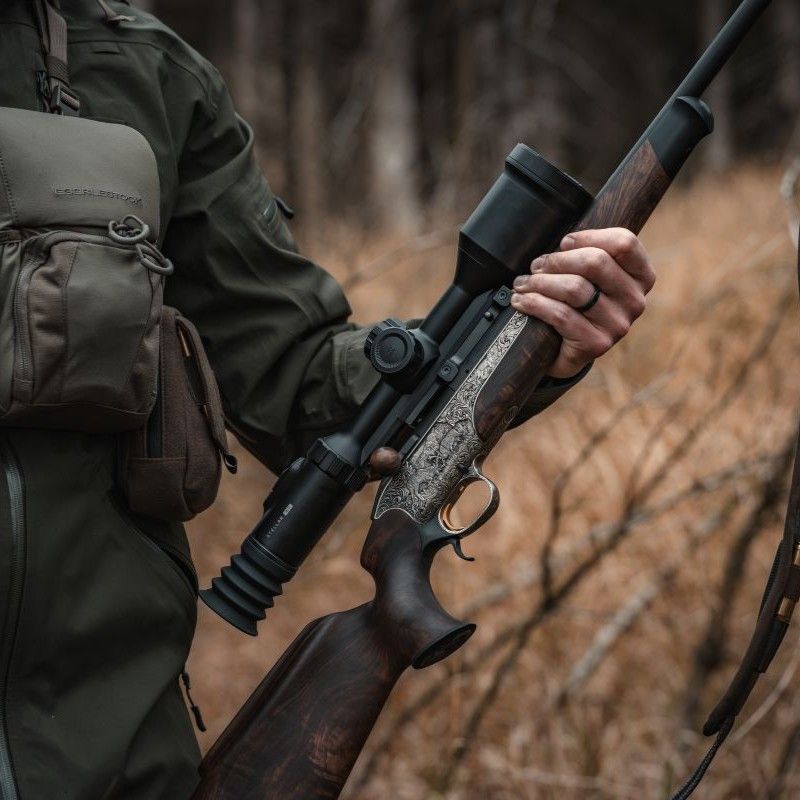
What the 1280 Sensor and 75mm Lens Actually Change
The SX75's 1280 × 1024 detector holds 1,310,720 pixels against 327,680 on the SQ50's 640 × 512, exactly four times as many. That is a fact. What it means in the field is interpretation, so here it is step by step:
1280 × 1024 sensor → more native thermal information → more detail still available as you zoom → easier assessment of animals at distance → most useful to shooters who regularly need to judge what they are looking at, not just that something is there.
Both scopes use a 12µm pixel pitch, which means the 1280 sensor is physically twice as wide and twice as tall as the 640. That explains something that surprises people: the SX75 has a longer 75mm lens, yet its field of view is wider than the SQ50's (12.1° against 8.8°), and its base magnification is lower (3.0× against 3.5×). You are not trading scanning width for reach in the way you would with a bigger lens on the same sensor.
We can put a rough number on the detail difference from the published figures. At 100m the SQ50 spreads a 15.2m-wide view across 640 pixels, about 2.4cm per pixel. The SX75 spreads a 21.2m-wide view across 1280 pixels, about 1.7cm per pixel. So the SX75 samples the scene roughly 1.4 times more finely while showing about 40% more width. This is our own calculation from HIKMICRO's specifications, horizontal only and approximate, but it shows why the SX75 should hold more usable detail when you zoom in.
What does not change. Both scopes list NETD below 12mK, which is better than the 15mK point where our thermal scoring framework's top band begins. The SX75's advantage is therefore not extra sensitivity on a cold, damp night. It is extra detail, and the 75mm lens to use it.
The detection range figures need care. HIKMICRO quotes 3,600m for the SX75 and 2,600m for the SQ50. Those describe detection of a target under defined test conditions. They are not distances at which you can identify what you are looking at, or safely take a shot.
Zoom. The SQ50 zooms from 3.5× to 28× and the SX75 from 3.0× to 30×. HIKMICRO's Zoom Pro processing is designed to reduce pixelation at higher magnifications. Even so, a scope that starts with more native pixels has more to work with, which is why the SX75's extra headroom is most valuable to those who zoom in often.
A 640 × 512 thermal with a 50mm lens remains an excellent tool at the ranges where most foxing and pest control happens. The SX75's extra detail earns its price when the distances are longer or the cost of misidentifying an animal is higher.
Built-in LRF, Ballistics, Recoil Rating and Mounting
Laser rangefinder. HIKMICRO's datasheets list a 905nm Class 1 laser rangefinder on all four models, with a 10m minimum range, a 1,200m maximum and ±1m accuracy. On the SX75 it is concealed in the lens, which gives that scope its cleaner, more traditional look. On the SQ50 it is built into the scope body. The practical chain is: integrated LRF → a measured distance without a separate device → a ballistic holdover worked out for that distance → fewer misjudged shots at the longer ranges where drop and wind start to matter.
Zeroing and ballistics. There are five zeroing profiles and a freeze-zeroing function, so one scope can be set up for more than one rifle or load. The ballistic calculator uses the rangefinder's measurement. If you swap between calibres or loads, the profiles are a real convenience rather than a spec-sheet extra.
Recoil. HIKMICRO rates the Stellar 4.0 to 6,000J of recoil. Treat that as the manufacturer's figure and, as with any thermal scope, check your zero after mounting and after your first shots rather than assuming it. Recoil-activated recording, with audio, saves footage automatically around each shot.
Mounting and handling. The L models take standard 30mm rings. The LR models are rail-mounted, for shooters who prefer a rail mount. The SQ50 has a 36mm centre height and the SX75 41mm, so check that your rings and stock comb height suit the extra 5mm before you buy. Eye relief is 55mm, and the controls follow riflescope convention, with a side focus ring and a rear magnification ring. Minimum focus distance is 10m on both.
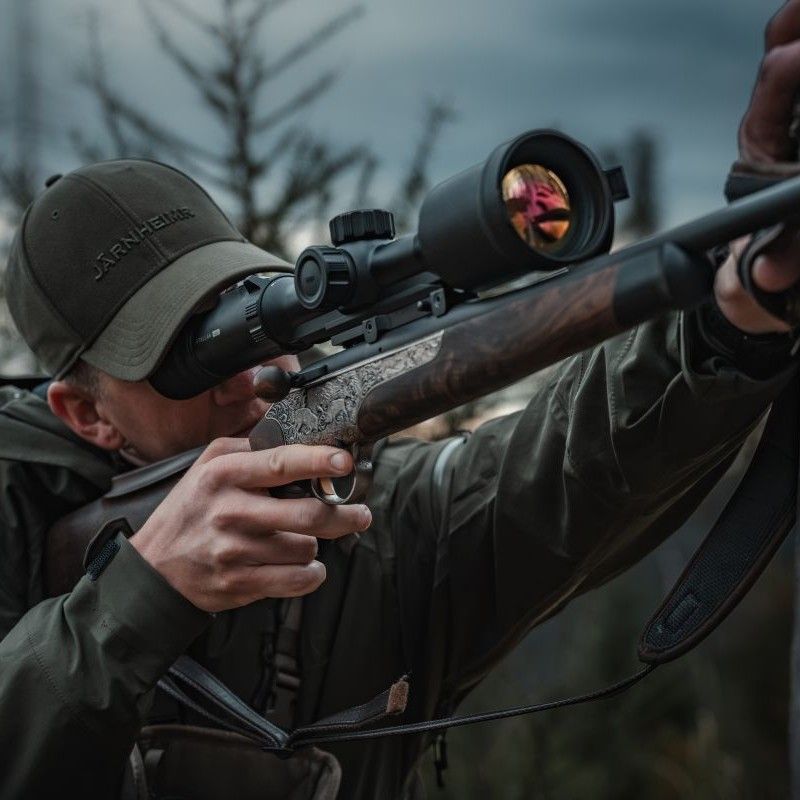
Compromises to Weigh Up
Weight. The range runs from 1,008g (SQ50L) to 1,140g (SX75LR) with the external battery fitted. That is substantial on a long stalk or a lightweight rifle, and you will feel it more if you shoot freehand.
Size. The SX75 is 6mm longer, 10.6mm wider and 4.4mm taller than the SQ50, and its centre height is 5mm higher. Check rings and stock fit.
Battery life. The SX75 runs for 7 hours against the SQ50's 9.5 hours, both with the LRF on at 25°C. Cold weather will reduce this, as it does for any battery.
Minimum focus. 10m on both models, so they are not close-range ratting scopes.
Charging. The USB-C port charges only the internal batteries. The external 18650 needs the supplied battery charger.
Detail depends on the whole system. More pixels do not fix poor handling or a mismatched mount. A well-set-up SQ50 will beat a badly set-up SX75.
Who Should Buy Which?
The SQ50 suits fox and pest shooters working woodland edges, farmland and mixed ground who want a capable thermal rifle scope with a built-in rangefinder and ballistic tools. It also suits anyone moving into a dedicated thermal scope for the first time, and shooters who value the lower weight and longer runtime.
The SX75 suits professional deer managers, stalkers and contractors who need to judge animals and groups at distance, and long-range foxing and pest-control shooters who zoom in routinely. It is for people whose work or ground uses the extra detail often enough to justify the cost.
L or LR? Choose the L (SQ50L or SX75L) if you already use, or prefer, standard 30mm rings. Choose the LR (SQ50LR or SX75LR) if you want rail mounting.
Who may prefer something else?
If you want to keep your existing day scope and zero, a thermal clip-on is a different route, with its own trade-offs in balance and workflow. Our range of thermal clip-on systems covers it, and the HIKMICRO Thunder 3.0 range is one place to start.
If you are unsure whether you need a thermal scope or a handheld thermal first, read thermal monocular vs thermal rifle scope: which should you buy first.
For close-range pest control with an air rifle, a lighter scope with closer focus will handle better than either Stellar.
FAQ
What is the difference between the SQ50 and SX75?
The SQ50 has a 640 × 512 sensor and 50mm F1.0 lens. The SX75 has a 1280 × 1024 sensor and 75mm F1.2 lens, a wider 12.1° × 9.7° field of view and a larger, heavier body. Both share NETD below 12mK, a 1,200m laser rangefinder and a 6,000J recoil rating.
What does the L and LR in the model names mean?
All four models have the built-in laser rangefinder. The L versions take standard 30mm rings and the LR versions are rail-mounted.
Does the Stellar 4.0 have a built-in laser rangefinder?
Yes. HIKMICRO lists a 905nm Class 1 laser rangefinder, concealed in the lens on the SX75 and built into the scope body on the SQ50, measuring from 10m to 1,200m with ±1m accuracy.
Is 1280 resolution worth the extra money over 640?
It depends on your use. The SX75 carries four times the native pixels and holds more detail when you zoom, which matters most for deer management and longer-range work. For foxing at typical ranges, a 640 scope such as the SQ50 is already very capable.
Is the detection range the same as the distance I can identify an animal?
No. HIKMICRO's 2,600m (SQ50) and 3,600m (SX75) figures are detection ranges under defined conditions. How far you can identify and safely shoot depends on the animal, the conditions and the situation.
Can I use the Stellar 4.0 for air rifle ratting?
We would not recommend it. Minimum focus is 10m and each scope weighs over 1kg, which makes both a poor match for close-range air rifle work.
How long does the battery last?
HIKMICRO quotes 9.5 hours for the SQ50 and 7 hours for the SX75, both at 25°C with the LRF on. Each scope uses internal batteries plus a replaceable, rechargeable 18650 battery.
Can I charge it over USB-C?
Only the internal batteries charge through the USB-C port. The external 18650 battery charges in the supplied battery charger.
What warranty does it have?
HIKMICRO lists 3 years on the product, 1 year on the batteries and 10 years on the detector.
Click Here to Shop HIKMICRO Stellar 4.0 Thermal Rifle Scopes